
Bernard Arnault is one of the most influential businessmen in the global luxury industry and the chairman and chief executive officer of LVMH, the parent company behind Louis Vuitton, Christian Dior, Moët & Chandon, Tiffany & Co., Bulgari and Sephora. Through decades of acquisitions, strategic investments and brand development, the French billionaire transformed a relatively small family business into one of the world's largest luxury conglomerates.
Arnault became the world's richest person in Forbes' annual billionaire rankings in 2023 and retained the position in 2024. His fortune subsequently declined as luxury stocks experienced market pressure and other technology billionaires moved ahead. As of November 22, 2026, Forbes estimated his family's wealth at approximately $114 billion, ranking them 17th globally.
Beyond his business empire, Arnault is known for his private lifestyle, extensive art collection, marriage to Canadian concert pianist Hélène Mercier and association with the 101.5-meter superyacht Symphony. His five children also occupy influential positions within the LVMH organization, making family succession an increasingly important subject for investors.
Who Is Bernard Arnault?
Bernard Jean Étienne Arnault was born on March 5, 1949, in Roubaix, northern France. He comes from an industrial family whose business interests were originally concentrated in construction and property development.
Arnault attended the École Polytechnique in Paris, one of France's most prestigious engineering institutions. He graduated in 1971 and subsequently joined his family's construction company, Ferret-Savinel, where he initially worked as an engineer.
He gradually moved into senior management and became chairman of the company in 1978. During this period, he developed an interest in business acquisitions and financial restructuring, skills that would later become central to his expansion into the luxury industry.
His career changed significantly in 1984 when he acquired control of the financially troubled Boussac Saint-Frères group, which owned Christian Dior. This transaction provided his entry into the luxury fashion business and established Dior as the foundation of his future commercial empire.
In 1989, Arnault became the majority shareholder of LVMH Moët Hennessy Louis Vuitton. He has served as its chairman and CEO since then, building the company through acquisitions, brand investment and international expansion.
Bernard Arnault's Net Worth in 2026
Bernard Arnault's wealth is primarily derived from his ownership and control of LVMH through family investment companies. His fortune is closely connected to the market value of the luxury conglomerate, meaning it can change significantly depending on stock market performance, investor expectations and global demand for luxury products.
According to Forbes' real-time billionaire profile, Bernard Arnault and his family had an estimated net worth of $114 billion as of November 22, 2026. Forbes ranked them 17th among the world's wealthiest individuals and families.
It is important to distinguish this current ranking from his historical position. Arnault topped Forbes' annual billionaire rankings in both 2023 and 2024, when his fortune was estimated at $211 billion and $233 billion, respectively.
His wealth subsequently declined as the luxury sector faced weaker demand, particularly in China, currency fluctuations and changing consumer spending patterns.
How His Wealth Is Structured
Unlike entrepreneurs whose fortunes are concentrated in technology companies or publicly traded financial assets, Arnault's wealth is heavily connected to the luxury industry.
His family controls LVMH through a network of holding companies, including Groupe Arnault and Agache. These structures allow the family to maintain substantial influence over the conglomerate's strategic direction and corporate governance.
His major sources of wealth include:
- LVMH: His primary source of wealth through the family's controlling investment in the luxury conglomerate.
- Christian Dior: The fashion house that played a central role in his entry into luxury goods and remains important to the family's corporate structure.
- Groupe Arnault: The family's investment holding company, which manages interests beyond LVMH.
- Aglaé Ventures: A venture capital investment platform associated with the family's investment activities.
- Other investments: Interests in private equity, technology, real estate and other businesses.
Forbes also identifies investments associated with the family's portfolio, including Netflix and ByteDance, the parent company of TikTok.
How Bernard Arnault Built the LVMH Luxury Empire
The foundation of Arnault's business success was his ability to recognize the commercial potential of prestigious brands and turn them into globally scalable businesses.
When he acquired Boussac Saint-Frères in 1984, the group was experiencing serious financial difficulties. Its assets included Christian Dior, which Arnault identified as the most valuable foundation for developing a luxury business.
His next major opportunity came through LVMH, created in 1987 following the merger of Louis Vuitton and Moët Hennessy. Arnault gradually gained control and became its majority shareholder in 1989.
Rather than concentrating on a single fashion label, he pursued an acquisition strategy that brought established luxury houses under one corporate organization.
The approach allowed LVMH to combine independent brand identities with centralized financial resources, international distribution networks and operational expertise.
Major Brands Owned by LVMH
LVMH operates approximately 75 luxury houses across several business categories. Its portfolio covers fashion, leather goods, champagne, spirits, cosmetics, jewelry, watches and luxury retail.
Some of its most recognizable brands include:
Fashion and Leather Goods
- Louis Vuitton
- Christian Dior
- Fendi
- Givenchy
- Celine
- Loro Piana
- Loewe
- Marc Jacobs
- Rimowa
Wines and Spirits
- Moët & Chandon
- Dom Pérignon
- Hennessy
- Veuve Clicquot
- Krug
- Ruinart
- Chandon
Watches and Jewelry
- Tiffany & Co.
- Bulgari
- TAG Heuer
- Hublot
- Zenith
- Chaumet
- Fred
Perfumes, Cosmetics and Retail
- Sephora
- Parfums Christian Dior
- Guerlain
- Givenchy Beauty
- Benefit Cosmetics
- Make Up For Ever
- Fresh
The diversity of these businesses helps LVMH reach different consumer markets while maintaining its positioning in premium and luxury products.
Bernard Arnault's Biggest Business Acquisitions
Acquisitions have been one of the most important elements of Arnault's expansion strategy. Instead of building every brand from the beginning, he acquired established companies with recognizable identities and opportunities for international growth.
Christian Dior in 1984
His acquisition of Boussac Saint-Frères in 1984 gave him control of Christian Dior. The fashion house became the cornerstone of his luxury business strategy and helped establish his position in the French fashion industry.
Sephora in 1997
LVMH acquired Sephora in 1997, expanding its presence in the international beauty retail market. The company developed into one of the world's most recognizable beauty retailers, combining premium cosmetics with a broad selection of international brands.
Tiffany & Co. in 2021
One of Arnault's most significant acquisitions was Tiffany & Co. LVMH completed the transaction in January 2021 for approximately $15.8 billion.
The acquisition strengthened the group's position in luxury jewelry and gave it control of one of the most recognizable American luxury brands.
Tiffany subsequently underwent a major brand and retail repositioning under LVMH ownership, including store renovations, product development and renewed marketing campaigns.
Other Strategic Investments
Arnault's investment activities extend beyond traditional fashion and luxury retail. Through Groupe Arnault and associated investment companies, his family has participated in venture capital, private equity, technology and other businesses.
The family also acquired a majority stake in French football club Paris FC in 2024, expanding its involvement in professional sports and entertainment.
How Much Revenue Does LVMH Generate?
LVMH's financial performance provides a clearer picture of the scale of Arnault's business empire.
For the first nine months of 2026, the group reported revenue of €57.1 billion, compared with €58.1 billion during the same period in 2025. Although reported revenue declined by approximately 2%, organic revenue increased by 2% after adjusting for currency fluctuations and changes in the consolidation scope.
The performance differed considerably across its business divisions.
| Business division | Revenue, first 9 months 2026 | Organic growth |
|---|---|---|
| Wines & Spirits | €4.03 billion | +5% |
| Fashion & Leather Goods | €26.39 billion | -2% |
| Perfumes & Cosmetics | €5.92 billion | 0% |
| Watches & Jewelry | €7.73 billion | +8% |
| Selective Retailing | €12.48 billion | +6% |
The figures highlight the continued importance of fashion and leather goods, which generated the largest share of group revenue. However, weaker demand in China affected the division, particularly during the third quarter.
Meanwhile, watches and jewelry, wines and spirits, and selective retailing recorded positive organic growth during the nine-month period.
The results demonstrate that even the world's largest luxury groups remain sensitive to changes in consumer confidence, economic conditions and regional demand.
Bernard Arnault's Yacht: Inside the 101.5-Meter Symphony
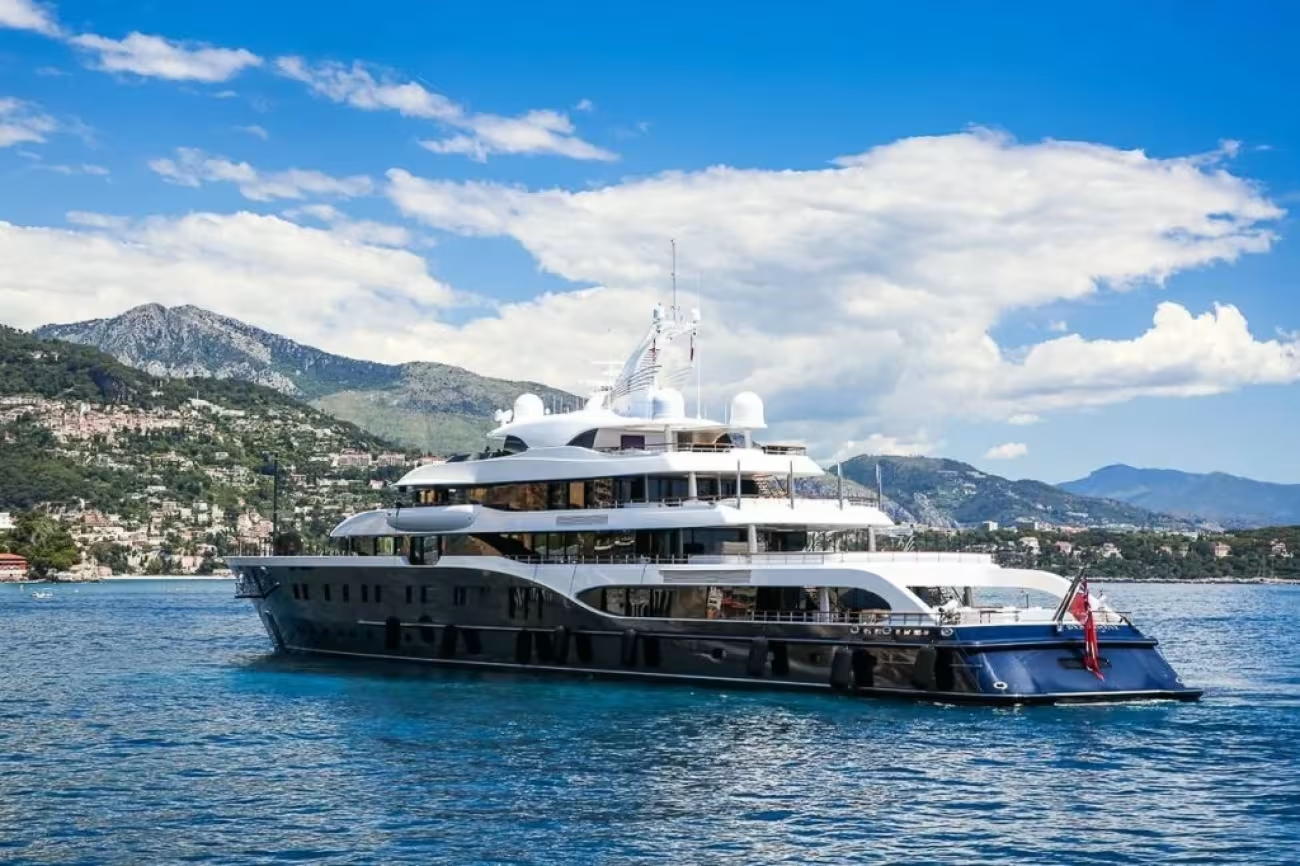
One of the most recognizable symbols of Arnault's private lifestyle is the superyacht Symphony, a 101.5-meter luxury vessel built by Dutch shipbuilder Feadship and delivered in 2015.
The yacht is widely associated with Bernard Arnault and his family investment structure. Its design reflects the same emphasis on craftsmanship, premium materials and exclusivity that characterizes LVMH's luxury brands.
According to Feadship's official specifications, Symphony was the first yacht built by the shipyard to exceed 100 meters in length.

Symphony, a 101.5-meter Feadship superyacht launched in 2015.
Symphony Yacht Specifications
| Specification | Details |
|---|---|
| Name | Symphony |
| Shipbuilder | Feadship |
| Year | 2015 |
| Length | 101.5 meters (333 feet) |
| Beam | 14.98 meters |
| Naval architect | Feadship De Voogt Naval Architects |
| Exterior design | Tim Heywood Design |
| Interior design | François Zuretti Interior Design |
| Guest capacity | Up to 36 guests under the Passenger Yacht Code |
| Cruising range | 5,500 nautical miles at 14 knots |
Symphony is notable for its extensive interior customization. Feadship has described the vessel as incorporating nearly 200 different finishes, demonstrating the level of craftsmanship involved in its construction.
One of its most distinctive features is a beach club with a six-meter glass-bottom swimming pool and waterfall. The yacht also incorporates extensive leisure facilities designed for long-distance private cruising.
Its construction illustrates the relationship between Arnault's personal luxury interests and the wider business environment surrounding LVMH, although yacht ownership and corporate structures should not be confused with direct ownership by the listed company.
How Much Is Bernard Arnault's Yacht Worth?
The exact current market value of Symphony has not been publicly established through a verified transaction.
Various yacht-industry publications have published estimates approaching $150 million to $200 million, depending on their valuation assumptions. These figures should be treated as estimates rather than confirmed purchase or resale prices.
The actual cost of operating a yacht of this size is also substantial. Expenses include crew salaries, maintenance, insurance, fuel, port fees, technical inspections and periodic refitting.
Bernard Arnault's Previous Yacht: Amadeus
Before Symphony, Arnault was associated with another large vessel named Amadeus, a 70-meter yacht with an unusual history.
The vessel was originally constructed in 1969 as a research ship before being converted into a luxury private yacht during the 2006–2007 period.
After Symphony entered service, Amadeus was sold. The vessel subsequently underwent name changes and became known as Felix before later being renamed Redemption.
The yacht's history illustrates the scale of Arnault's interest in luxury maritime assets, although its current ownership should not be attributed to him.
Who Is Bernard Arnault's Wife?
Bernard Arnault is married to Hélène Mercier Arnault, a Canadian concert pianist known for her international performances and classical music recordings.
The couple married in 1991 and have three sons together: Alexandre, Frédéric and Jean. Arnault also has two older children, Delphine and Antoine, from his previous marriage to Anne Dewavrin.
Hélène Mercier was born in Montreal, Canada, and began studying piano at a young age. She later pursued musical studies in Vienna and at the Juilliard School in New York before establishing an international concert career.
She has performed with prominent classical musicians and has maintained an independent professional identity despite being married to one of the world's wealthiest businessmen.
How Bernard Arnault Met Hélène Mercier
In a February 2026 interview with Vogue, Mercier described how she first met Arnault at a dinner party in Paris.
After the event, Arnault offered to drive her home. During their brief conversation, he discussed his interest in playing the piano and the classical compositions he practiced.
He subsequently invited her to lunch at his Dior office and arranged a tour of the fashion house's boutique.
Mercier explained that she initially did not fully understand his professional position and only discovered the extent of his business influence later.
Their shared appreciation of classical music became an important part of their relationship. Arnault himself is an accomplished amateur pianist and has used his musical interests to connect with his wife.
Hélène Mercier's Music Career
Mercier has continued performing internationally throughout her marriage. Her musical work includes collaborations with renowned instrumentalists and appearances at major cultural events.
In March 2026, she released the album Lost to the World with Swedish violinist Daniel Lozakovich.
She has also discussed her appreciation for contemporary music, including hip-hop, and her interest in collaborations that combine different musical genres.
Her career demonstrates that she maintains her own artistic activities rather than functioning solely as the spouse of a business executive.
Bernard Arnault's Five Children and Family Business
Arnault has five children, all of whom have developed careers within the luxury and investment businesses associated with the family.
His children are:
- Delphine Arnault: His eldest daughter from his first marriage, who leads Christian Dior Couture.
- Antoine Arnault: His eldest son from his first marriage, who has held senior responsibilities involving communications, image and the family's corporate interests.
- Alexandre Arnault: His son with Hélène Mercier, who has held senior executive positions within LVMH, including at Moët Hennessy.
- Frédéric Arnault: His son with Mercier, who has held leadership responsibilities in the group's watch and luxury businesses, including Loro Piana.
- Jean Arnault: His youngest son, who has been involved in Louis Vuitton's watch division.
The involvement of all five children reflects Arnault's long-term approach to family ownership and management succession.
However, their responsibilities are not identical, and each has developed a different professional background within the group.
Who Will Succeed Bernard Arnault at LVMH?
Succession is one of the most closely watched subjects surrounding LVMH because Arnault has maintained control of the group for decades.
His five children occupy influential positions, but no definitive successor has been publicly designated.
In July 2026, Le Monde reported that Arnault had indicated that a leadership transition was not expected in the immediate future, describing a possible horizon of seven or eight years.
The question is important for investors because LVMH's ownership and management structure is closely connected to the Arnault family.
Potential succession arrangements involve more than choosing a chief executive. They also concern the family's voting rights, ownership vehicles, corporate governance and the distribution of responsibilities among its next generation.
The challenge is to maintain strategic continuity while ensuring that the group can continue operating effectively beyond Arnault's leadership.
Latest Bernard Arnault and LVMH News in November 2026
One of the most important recent developments involving Arnault is the family's plan to simplify its ownership structure through Christian Dior.
On November 20, 2026, Reuters reported that Christian Dior's board had approved the terms of a proposed merger involving the family holding company Agache and Christian Dior, alongside a conversion of the company into a limited joint-stock partnership.
Under the proposed structure, the combined listed entity would directly hold 49.76% of LVMH's share capital and 65.55% of its voting rights.
Shareholders are scheduled to vote on the transaction on December 30, 2026. If completed, the arrangement would further consolidate the family's control through a simplified corporate structure.
The proposal also includes a cash tender offer for Christian Dior shares not already owned by the family group, subject to the completion of the restructuring.
LVMH's Business Performance in 2026
Arnault also faces a challenging operating environment in the global luxury market.
LVMH's October 2026 financial update reported €57.1 billion in revenue for the first nine months of the year, with organic growth of 2%.
Demand conditions varied by region. The United States, Europe and Japan recorded positive momentum, while China remained a less buoyant market during the third quarter.
Fashion and leather goods, the group's largest division, experienced negative organic growth of 2% during the first nine months. By contrast, watches and jewelry recorded 8% organic growth.
The results demonstrate the importance of regional diversification and brand management in maintaining LVMH's long-term performance.
Bernard Arnault's Art Collection and Cultural Investments
Arnault is also known for his interest in contemporary art, architecture and cultural institutions.
One of his most important cultural projects is the Fondation Louis Vuitton in Paris, a contemporary art museum housed in a building designed by architect Frank Gehry.
The foundation supports exhibitions, artistic programs and cultural initiatives, reflecting Arnault's broader interest in positioning LVMH as a contributor to French art and cultural heritage.
His personal art collection has been associated with major artists including Pablo Picasso, Andy Warhol, Yves Klein and Henry Moore.
In 2019, Arnault and LVMH pledged €200 million toward the restoration of Notre-Dame Cathedral following the devastating fire in Paris.
These activities demonstrate how the family's interests extend beyond commercial luxury goods into art, architecture and cultural patronage.
Conclusion: Bernard Arnault's Wealth, Family and Business Legacy
Bernard Arnault's rise from a family construction business to the leadership of LVMH represents one of the most significant business stories in the modern luxury industry.
Through the acquisition and development of established fashion houses, jewelry companies, beauty retailers and champagne brands, he built a global business empire that continues to influence consumer culture and international markets.
His wealth, once sufficient to make him the world's richest person, remains closely tied to LVMH's financial performance. His private lifestyle, marriage to Hélène Mercier and association with the superyacht Symphony also attract considerable public attention.
As of November 2026, the next major questions surrounding Arnault concern the future leadership of LVMH, the role of his five children and the family's proposed ownership restructuring.
His legacy will ultimately depend not only on the scale of the luxury empire he created but also on whether the family can preserve its influence and the group's commercial strength through the next generation.