
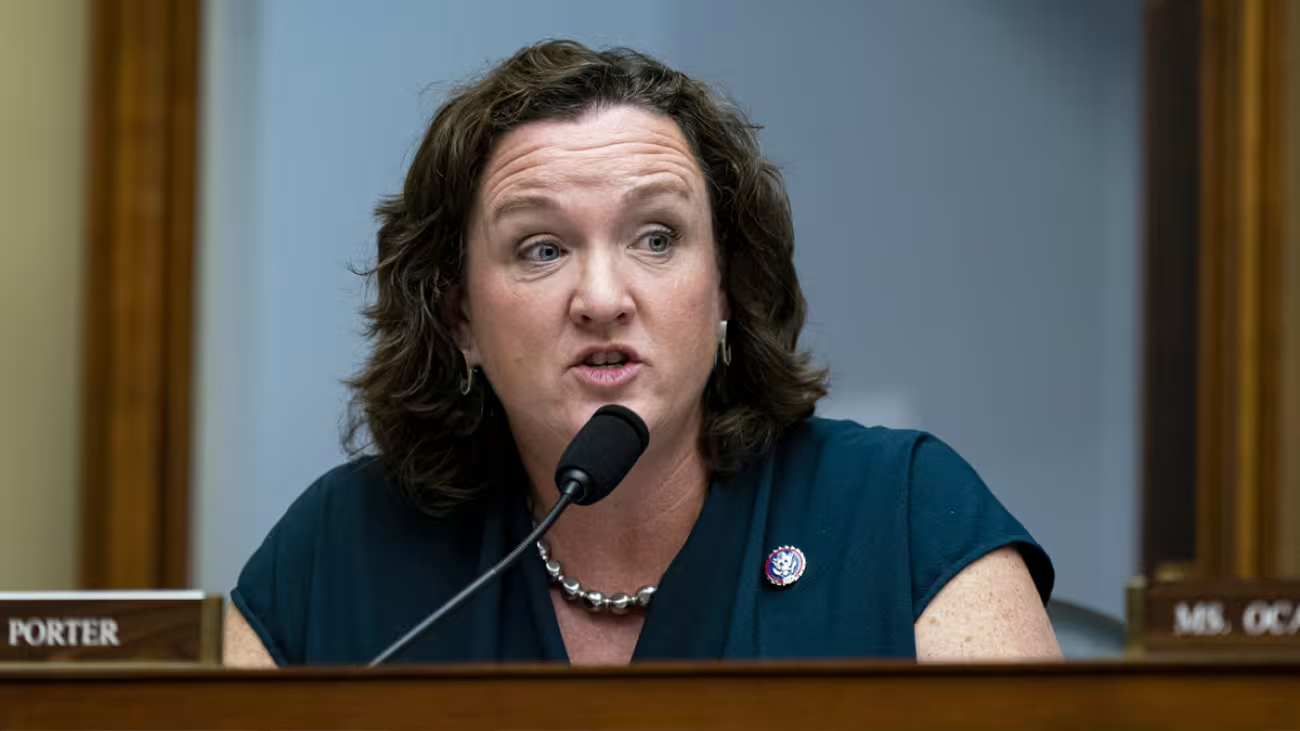
Rather than avoiding the controversy, Porter eventually incorporated the incident into her campaign messaging.
On May 5, 2026, she released a 30-second campaign advertisement that made a direct reference to the viral staff video.
In the advertisement, Porter walks through a grocery store, pumps gas, and speaks about everyday financial pressures facing California residents. Supporters and campaign staff appear behind her holding whiteboards with messages about healthcare, fuel prices, and political issues.
At the end of the advertisement, Porter turns toward the people behind her and says:
"Now, could you guys please get out of my shot?"
The comment deliberately echoed her 2021 outburst. The people behind her responded with laughter, turning the previously embarrassing moment into a self-deprecating campaign joke.
According to People, the advertisement was also intended to highlight her background, political identity, and familiar whiteboard presentation style.
The approach showed that Porter was willing to acknowledge the footage publicly rather than allowing opponents to control the discussion entirely. However, the advertisement did not eliminate questions about her interactions with employees.
Did the Resurfaced Videos Affect Katie Porter's Governor Campaign?
The videos became a recurring issue during Porter's campaign, particularly when she was trying to establish relationships with Democratic Party leaders, labor organizations, and potential supporters.
A May 11, 2026, Los Angeles Times report examined how the controversy affected her campaign. The newspaper described her direct and combative political style as both an important part of her public identity and a potential vulnerability.
Porter had built a following by challenging powerful corporate executives and confronting political opponents. However, some of the same characteristics that attracted supporters became subjects of criticism when the videos showed her interacting with people working alongside her.
The controversy also emerged during a competitive primary involving several prominent Democratic and Republican candidates.
Criticism From Democratic Political Figures
Several Democratic politicians and political figures publicly criticized Porter following the release of the footage.
Former California state controller Betty Yee called on her to leave the gubernatorial race after the interview with Julie Watts circulated online. Former Los Angeles Mayor Antonio Villaraigosa also criticized the exchange, arguing that voters deserved candidates willing to answer difficult questions.
Former Senator Barbara Boxer separately questioned Porter's ability to work collaboratively with others, citing concerns about her temperament.
These were political opinions expressed by individual figures, rather than established findings about Porter's professional abilities.
Supporters Raise Questions About a Gender Double Standard
Porter's supporters offered a different interpretation of the controversy, arguing that women in politics can face harsher judgments for behavior that might be treated differently when displayed by male politicians.
Some supporters compared the scrutiny surrounding Porter with the history of outspoken male political leaders who were known for confrontational communication styles.
The Los Angeles Times also examined this argument, noting that California had never elected a woman governor and that some political observers believed gender expectations influenced how voters interpreted the videos.
However, critics maintained that the central issue was not simply whether Porter was outspoken but whether the recorded interactions demonstrated appropriate professional conduct.
The debate therefore involved two related questions: how political leadership should be evaluated and whether public criticism is applied consistently across genders.
What Happened in the 2026 California Governor Primary?
Katie Porter's campaign ultimately ended in the June 2, 2026, California gubernatorial primary.
California uses a nonpartisan top-two primary system. Candidates from all political parties compete in the same primary, and the two candidates receiving the most votes advance to the November general election, regardless of party affiliation.
Porter finished fifth in the certified primary results, receiving 403,908 votes, equivalent to approximately 4.36% of the vote.
2026 California Governor Primary Results
| Candidate | Party | Votes | Vote Share |
|---|---|---|---|
| Xavier Becerra | Democrat | 2,591,857 | 27.98% |
| Steve Hilton | Republican | 2,277,318 | 24.59% |
| Tom Steyer | Democrat | 2,110,707 | 22.79% |
| Chad Bianco | Republican | 941,708 | 10.17% |
| Katie Porter | Democrat | 403,908 | 4.36% |
The California Secretary of State certified the primary results on July 10, 2026.
Porter acknowledged that she would not advance to the November election on primary election night. In her concession message, she thanked her supporters and campaign staff and emphasized the importance of continuing to participate in democratic processes.
Although the resurfaced videos were widely discussed during the campaign, the available evidence does not establish that they alone caused her primary result. The election involved multiple candidates, policy differences, fundraising, endorsements, and other political considerations.
Who Is Running in the California Governor Election Now?
After the June primary, the two candidates advancing to the November 3, 2026, general election were Democrat Xavier Becerra and Republican Steve Hilton.
Porter was therefore no longer a candidate in the general election.
As of November 25, 2026, the Associated Press had called the general election for Becerra. KQED's election results page reported approximately 65.6% for Becerra and 34.3% for Hilton, with 99% of votes counted.
California's official certification process was still underway. County election officials had until December 3 to complete their results, with the Secretary of State scheduled to certify the statewide results on December 11.
Katie Porter's Political Career Before the Controversy
Before becoming a prominent figure in the California gubernatorial race, Porter developed a reputation as a consumer protection advocate and progressive Democratic lawmaker.
She was elected to Congress in 2018, defeating Republican incumbent Mimi Walters in California's 45th Congressional District.
Her background as a bankruptcy law professor at the University of California, Irvine, influenced her approach to congressional oversight and financial regulation.
The Whiteboard That Made Her Famous
One of Porter's most recognizable political techniques was using a whiteboard during congressional hearings.
Rather than relying exclusively on lengthy questions, she frequently presented calculations, diagrams, and financial comparisons to challenge corporate executives and government officials.
Her questioning of representatives from pharmaceutical companies, banks, and other major corporations generated millions of online views.
The whiteboard became a recognizable part of her political identity and helped establish her as a prominent voice on consumer protection and corporate accountability.
Her Education and Legal Background
Porter attended Yale University, where she earned an undergraduate degree, before completing her law degree at Harvard Law School.
She subsequently worked as a law professor and developed expertise in bankruptcy law, consumer finance, and financial regulation.
Her academic and legal experience became important parts of her political career, particularly when addressing complicated economic issues in Congress.
What Were Katie Porter's Main Policies During Her 2026 Campaign?
Although the videos attracted considerable attention, Porter's gubernatorial campaign also focused on California's cost-of-living challenges and public services.
Her proposals included:
- Housing affordability: Making housing costs a central issue in state policy.
- Free childcare: Expanding access to childcare to reduce expenses for working families.
- College affordability: Proposing tuition assistance at University of California and California State University institutions for qualifying students.
- Income taxes: Proposing to eliminate state income taxes for Californians earning less than $100,000.
- Corporate taxation: Supporting higher taxes on highly profitable corporations to help finance public programs.
- Healthcare: Supporting a statewide single-payer healthcare system.
These proposals formed part of her broader message that California needed to become more affordable for working families.
Conclusion
Katie Porter's resurfaced videos became a major topic during her campaign for California governor. The footage from 2021 showed her angrily addressing a staff member, while another recording captured a tense exchange with CBS journalist Julie Watts.
Porter acknowledged that she mishandled the recorded interactions and said she apologized. She later addressed the controversy through interviews, public comments, and a campaign advertisement that humorously referenced the staff incident.
The controversy remained part of the broader discussion about her leadership style, workplace relationships, and approach to public criticism. Her supporters highlighted her record of challenging powerful interests, while critics questioned her interactions with colleagues and employees.
Ultimately, Porter finished fifth in the June 2026 California gubernatorial primary with 4.36% of the vote and did not advance to the general election.
Her campaign illustrates how a candidate's public communication style, professional relationships, policy proposals, and response to controversy can all become part of a modern political campaign. However, the election result should be understood in the context of the wider race rather than attributed to a single viral video.